Quelle est la différence entre Celsius et Kelvin : Guide scientifique complet (2026)
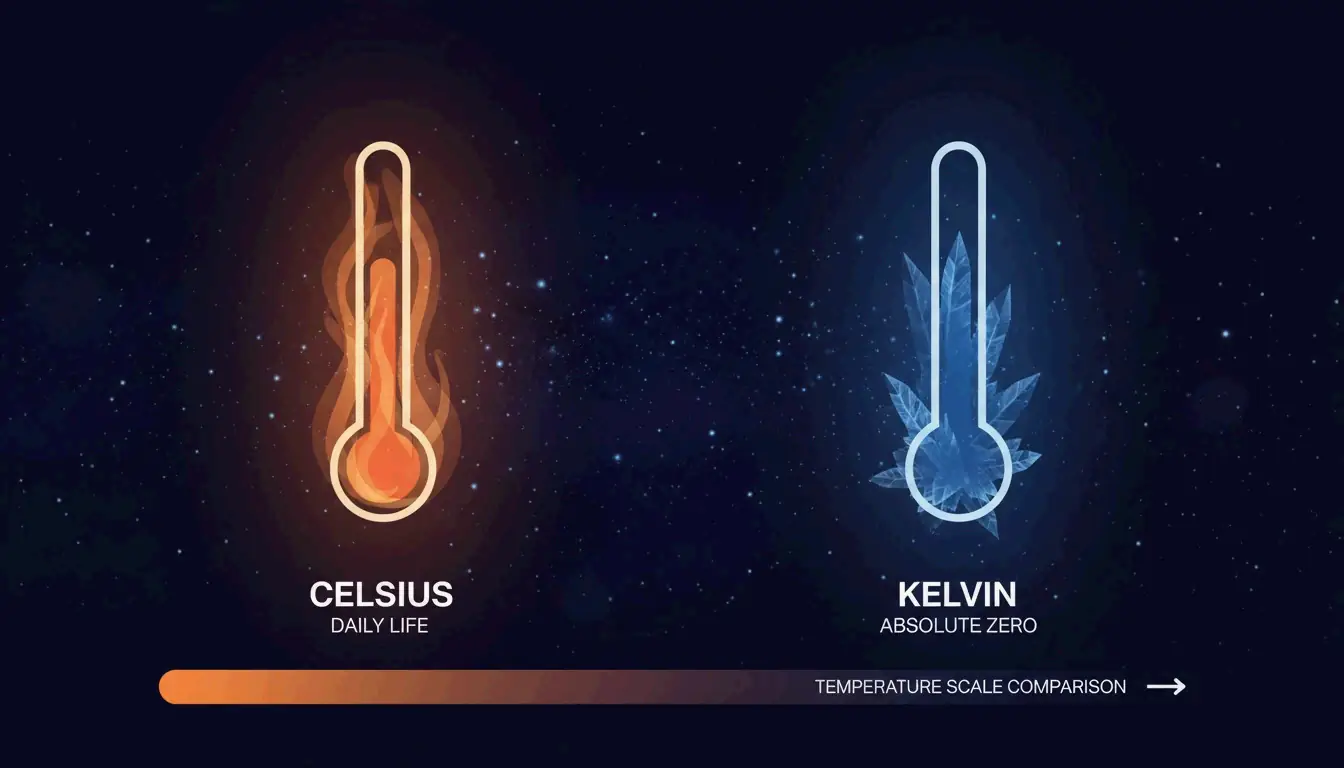
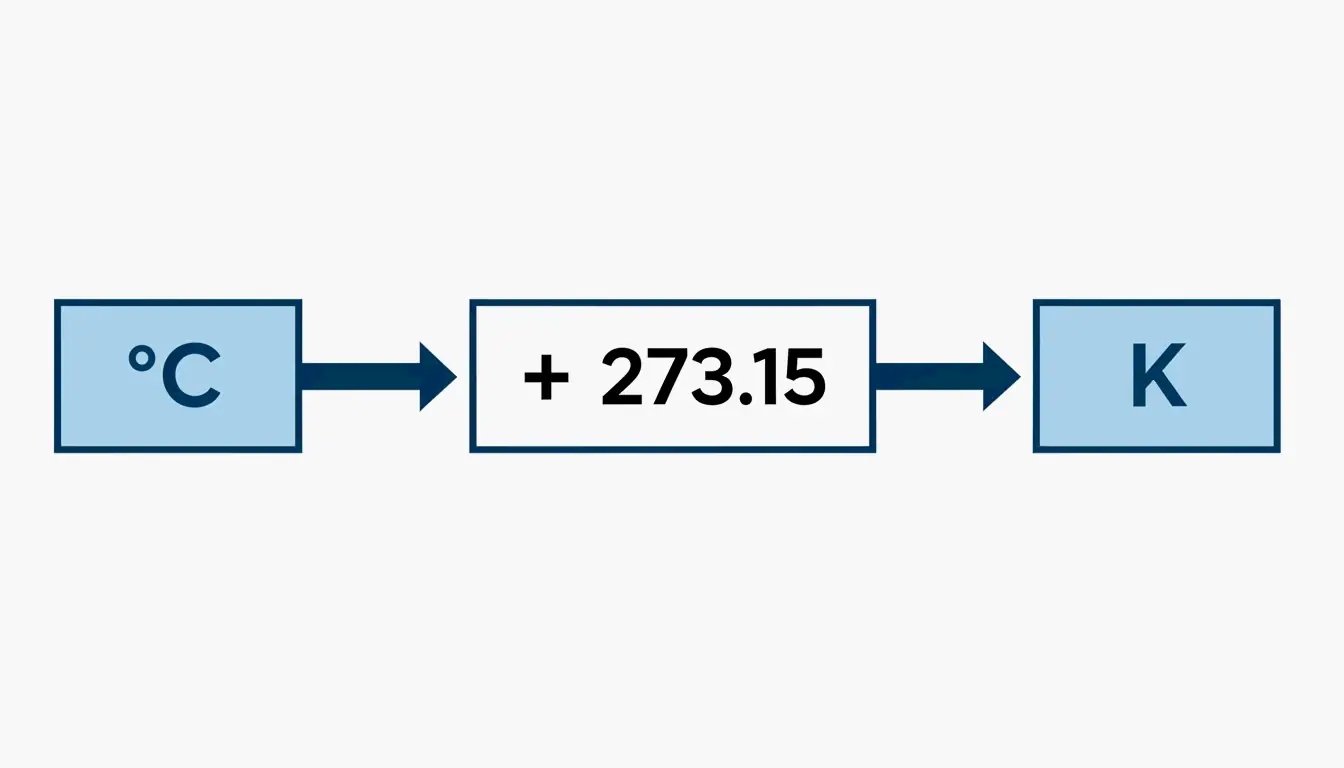
La différence entre Celsius et Kelvin réside dans leur point zéro : le Celsius commence au point de congélation de l’eau (0 °C), le Kelvin commence au zéro absolu (0 K). La taille du degré est identique — une variation de 1 °C correspond exactement à une variation de 1 K. Convertissez avec la formule K = °C + 273,15.
Celsius vs. Kelvin : Comparaison essentielle
| Propriété | Celsius (°C) | Kelvin (K) |
|---|---|---|
| Type d’échelle | Échelle d’intervalle | Échelle de rapport (absolue) |
| Point zéro | Congélation de l’eau (0 °C) | Zéro absolu (0 K) |
| Valeurs négatives | Oui | Jamais |
| Symbole du degré | °C | K (pas de symbole degré depuis 1967) |
| Ébullition de l’eau | 99,974 °C (ITS-90) | 373,124 K |
| Défini par | Transitions de phase de l’eau | Constante de Boltzmann (depuis 2019) |
| Utilisation principale | Vie quotidienne, météo | Science, thermodynamique, astronomie |
Pourquoi le zéro absolu est important
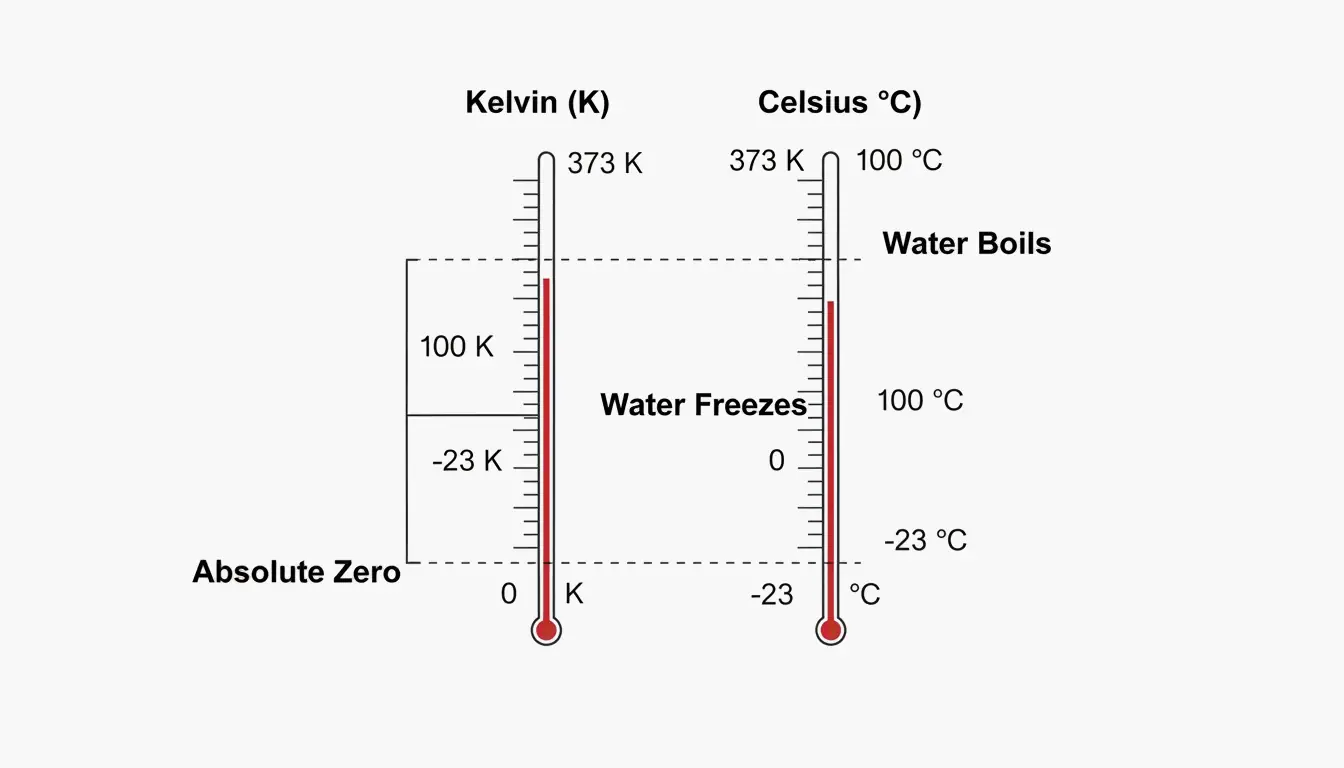
Selon Wikipédia, le zéro absolu est le point où les particules ont un mouvement thermique minimal. Cela se produit à −273,15 °C. Parce que le Kelvin commence à ce plancher physique, il permet des comparaisons de rapport — 400 K a exactement deux fois l’énergie thermique de 200 K. La même logique ne fonctionne pas avec le Celsius : 20 °C n’est pas « deux fois plus chaud » que 10 °C.
Rapport d’intervalle 1:1
Le NIST confirme que 1 kelvin = 1 degré Celsius en amplitude. Cela rend la conversion purement additive — aucune multiplication ni division nécessaire, juste le décalage de 273,15.
Conversion : Formule et exemples
| Direction | Formule | Exemple |
|---|---|---|
| °C → K | K = °C + 273,15 | 20 °C = 293,15 K |
| K → °C | °C = K − 273,15 | 300 K = 26,85 °C |
Selon Vedantu :
| Température courante | Celsius | Kelvin |
|---|---|---|
| Zéro absolu | −273,15 °C | 0 K |
| Congélation de l’eau | 0 °C | 273,15 K |
| Température ambiante | 20 °C | 293,15 K |
| Température corporelle | 37 °C | 310,15 K |
| Ébullition de l’eau | 99,974 °C | 373,124 K |
| Surface du Soleil | 5 499 °C | 5 772 K |
Erreur courante : Écrire « 300 °K » — incorrect depuis 1967. L’unité est simplement « K ».
Redéfinition du SI en 2019 : Constante de Boltzmann
| Avant 2019 | Après 2019 |
|---|---|
| Kelvin défini par le point triple de l’eau (273,16 K) | Kelvin défini par la constante de Boltzmann |
| La constante de Boltzmann avait une incertitude de mesure | La constante de Boltzmann est exacte : 1,380649 × 10⁻²³ J/K |
| Le point triple était exact | Le point triple a désormais une légère incertitude |
| Dépendait de la composition isotopique de l’eau | Ancré sur une constante physique universelle |
Selon le NIST, ce changement garantit que la mesure de température est indépendante de toute substance — un enjeu critique pour l’informatique quantique (processeurs au millième de kelvin) et les capteurs de l’espace lointain.
Pourquoi les scientifiques utilisent le Kelvin : La perspective énergétique
Selon Chemistry LibreTexts, le Kelvin est directement lié à l’énergie cinétique. Cela le rend essentiel pour :
| Application | Pourquoi le Kelvin est nécessaire |
|---|---|
| Loi des gaz parfaits (pV=nRT) | Utiliser le Celsius produit des pressions/volumes négatifs — physiquement impossible |
| Astronomie | Les températures des étoiles sont mesurées en Kelvin (Soleil : 5 772 K) |
| Cryogénie | Azote liquide à 77 K ; supraconducteurs près du zéro absolu |
| Thermodynamique | Les rapports d’énergie (E = k_BT) ne fonctionnent que sur une échelle absolue |
Les pionniers
| Scientifique | Contribution |
|---|---|
| Anders Celsius (1701–1744) | A proposé l’échelle centigrade (1742) ; originellement 0°=ébullition, 100°=congélation ; inversée à titre posthume |
| Lord Kelvin (1824–1907) | A proposé l’échelle thermométrique absolue (1848) ; a calculé le zéro absolu à ~−273 °C |
Conclusion
Le Celsius est relatif (échelle d’intervalle) ; le Kelvin est absolu (échelle de rapport). Les deux partagent des tailles de degré identiques, décalées de 273,15. Pour la vie quotidienne, utilisez le Celsius. Pour tout calcul scientifique impliquant des rapports d’énergie, des lois sur les gaz ou la thermodynamique, utilisez le Kelvin — sans le symbole du degré.
FAQ
Est-il correct de dire « degrés Kelvin » ?
Non. Selon les règles du SI depuis 1967, l’unité est « kelvins » (K). Écrivez « 300 K », jamais « 300 °K ».
Quelle température est identique en Celsius et en Kelvin ?
Aucune. Les deux échelles utilisent des intervalles identiques décalés de 273,15 — elles évoluent en parallèle et ne se croisent jamais. (Le Celsius et le Fahrenheit se rejoignent à −40.)
Pourquoi le Kelvin n’a-t-il pas de nombres négatifs ?
Le Kelvin commence au zéro absolu — le point d’énergie cinétique nulle. Puisqu’on ne peut pas avoir moins que zéro mouvement moléculaire, l’échelle commence à 0 et ne fait qu’augmenter.
SectoJoy
• Indie Hacker & DeveloperI'm an indie hacker building iOS and web applications, with a focus on creating practical SaaS products. I specialize in AI SEO, constantly exploring how intelligent technologies can drive sustainable growth and efficiency.