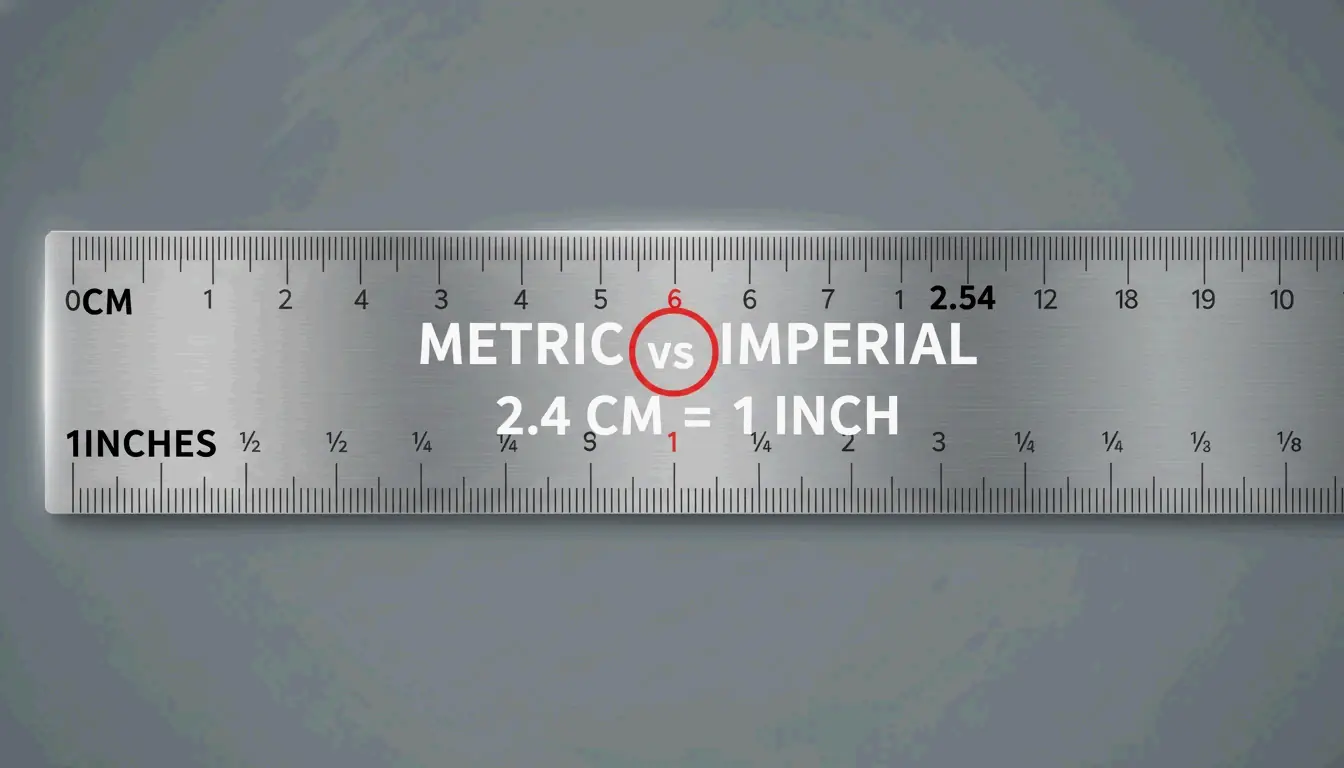
CM en Pieds et Pouces : Guide Ultime de Conversion et Tableau de Taille (2026)
Pour convertir des cm en pieds et pouces : divisez les cm par 2,54 pour obtenir le total en pouces, puis divisez par 12 pour les pieds avec le reste en pouces. Exemple : 180 cm = 70,87 in = 5’10,9″. Selon le NIST SP 811, 1 pied = exactement 30,48 cm, 1 pouce = exactement 2,54 cm.
La formule en 3 étapes
| Étape | Opération | Exemple (180 cm) |
|---|---|---|
| 1. Total en pouces | cm ÷ 2,54 | 180 ÷ 2,54 = 70,866 in |
| 2. Pieds | total pouces ÷ 12 (nombre entier) | 70,866 ÷ 12 = 5 ft |
| 3. Pouces restants | reste décimal × 12 | 0,866 × 12 = 10,4 in |
| Résultat | — | 5’10,4″ |
Alternative pour l’étape 3 : (cm d’origine − pieds × 30,48) ÷ 2,54 = pouces restants.
Ne remplacez jamais 2,54 par 2,5 — cela crée une erreur de 1,6 % qui s’accumule dans la construction et les dossiers médicaux.
Tableau de Taille : CM en Pieds et Pouces
| Centimètres | Pieds et Pouces (arrondi) | Impérial Exact | Contexte |
|---|---|---|---|
| 150 cm | 4’11” | 4’11,06″ | — |
| 155 cm | 5’1″ | 5’1,02″ | — |
| 159 cm | 5’3″ | 5’2,99″ | Moyenne mondiale féminine |
| 160 cm | 5’3″ | 5’2,99″ | — |
| 165 cm | 5’5″ | 5’4,96″ | — |
| 170 cm | 5’7″ | 5’6,93″ | — |
| 171 cm | 5’7″ | 5’7,32″ | Moyenne mondiale masculine |
| 175 cm | 5’9″ | 5’8,90″ | — |
| 180 cm | 5’11” | 5’10,87″ | — |
| 185 cm | 6’1″ | 6’0,83″ | — |
| 190 cm | 6’3″ | 6’2,80″ | — |
| 200 cm | 6’7″ | 6’6,74″ | — |
Moyennes de taille selon GIGAcalculator.
Variation Diurne
Les humains sont les plus grands le matin et peuvent rétrécir jusqu’à 1 cm (0,39 in) le soir à cause de la compression des disques spinaux due à la station debout.
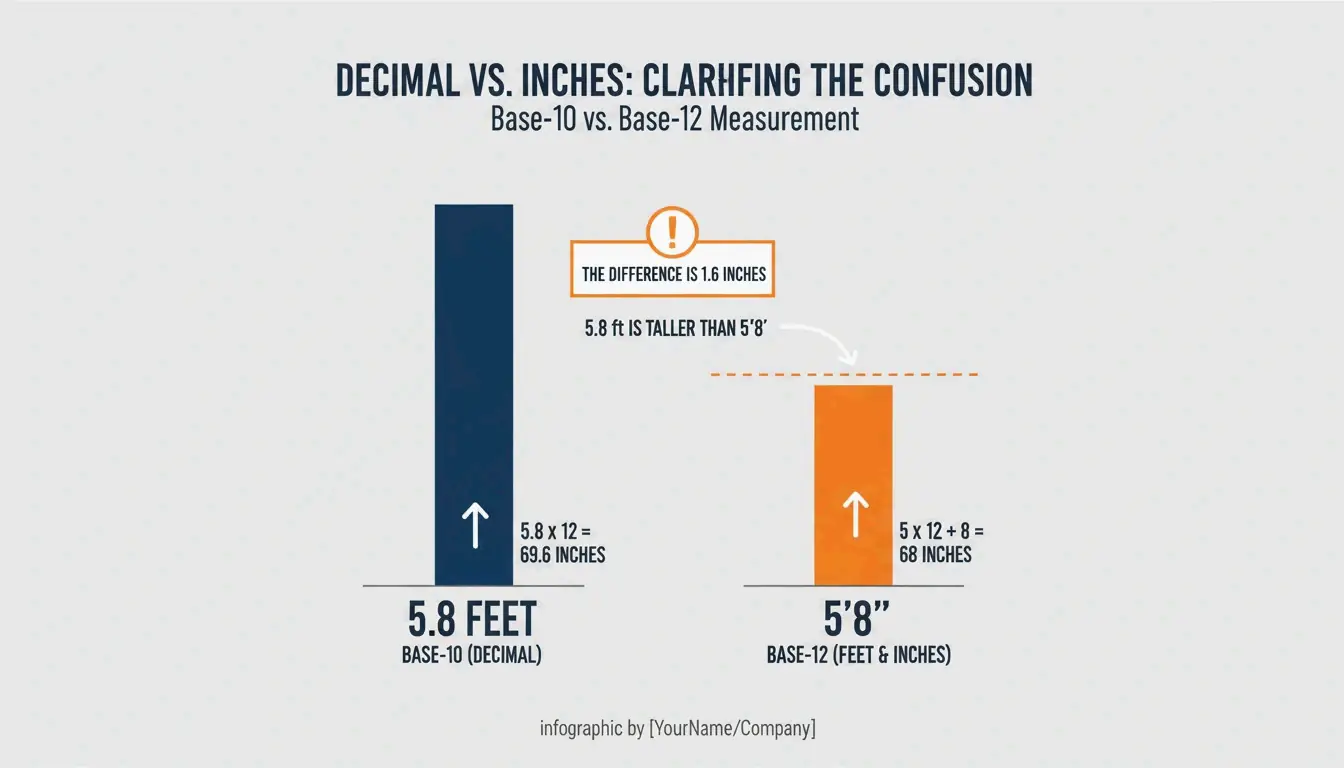
Pieds Décimaux ≠ Pieds + Pouces
Piège critique : 5,8 pieds n’est PAS 5’8″ — c’est 5’9,6″ (0,8 × 12 = 9,6 in).
| Interprétation erronée | Réalité | Écart |
|---|---|---|
| 5,8 ft lu comme 5’8″ | Réalité : 5’9,6″ | +1,6 pouces |
| 6,1 ft lu comme 6’1″ | Réalité : 6’1,2″ | +0,2 pouces |
| 5,5 ft lu comme 5’5″ | Réalité : 5’6,0″ | +1,0 pouces |
Pouces Décimaux en Fractions (Construction)
Pour les mètres rubans américains (base 16) :
| Pouces Décimaux | × 16 | Fraction |
|---|---|---|
| 0,25 in | 4/16 | 1/4″ |
| 0,50 in | 8/16 | 1/2″ |
| 0,75 in | 12/16 | 3/4″ |
| 0,0625 in | 1/16 | 1/16″ |
| 0,4375 in | 7/16 | 7/16″ |
Multipliez la partie décimale par 16, arrondissez au nombre entier le plus proche, puis simplifiez la fraction.
Normes : Accord de 1959 et Pied de Relevé US
| Norme | Définition | Statut (2026) |
|---|---|---|
| Pied international | 1 ft = 30,48 cm exactement | En vigueur |
| Pouce international | 1 in = 2,54 cm exactement | En vigueur |
| Pied de Relevé US | ~2 ppm de différence par rapport à l’international | Retiré le 1er janvier 2023 selon le NIST |
Le mètre est défini par la vitesse de la lumière (299 792 458 m/s) selon le BIPM.
Pratique : Conversion Ameublement et Maison (IKEA)
| Élément | Métrique (cm) | Impérial | Standard US | Écart |
|---|---|---|---|---|
| Lit Queen européen | 160 cm de large | 62,99 in | Queen US : 60 in | +3 pouces plus large |
| Plafond européen | 250 cm | 8’2,4″ | Plafond US : 8′ (243,84 cm) | +2,4 pouces plus haut |
| Porte standard | 200 cm | 6’6,7″ | Porte US : 6’8″ (203,2 cm) | −2,5 pouces plus court |
Les entrepreneurs doivent utiliser le facteur exact 2,54 lors de l’installation de meubles ou d’appareils importés.
Prédiction de la Taille des Enfants
| Méthode | Précision | Données requises |
|---|---|---|
| Méthode du Multiplicateur (Paley et al.) | 85 % à 5 cm près | Taille actuelle de l’enfant + âge |
| Khamis-Roche | Plus précise | Taille des deux parents requise |
Selon GIGAcalculator, la Méthode du Multiplicateur fonctionne dans toutes les ethnies et nécessite moins de données en entrée.
Conclusion
cm → total en pouces (÷2,54) → pieds (÷12) + pouces restants. Ne confondez jamais les pieds décimaux avec les pieds+pouces. Pour la construction, convertissez les pouces décimaux en fractions de 1/16. Pour les meubles importés, vérifiez les dimensions exactes en cm par rapport aux normes américaines avant tout achat.
FAQ
Pourquoi 5,8 pieds n’est-il pas la même chose que 5’8″ ?
Les pieds utilisent la base décimale (base 10) mais les pouces utilisent la base 12. Multipliez la partie décimale par 12 : 0,8 × 12 = 9,6 pouces. Donc 5,8 pieds = 5’9,6″, soit près de 2 pouces de plus que 5’8″.
Quelle est la taille moyenne mondiale ?
Selon GIGAcalculator : hommes 171 cm (5’7″), femmes 159 cm (5’3″). Varie considérablement selon les régions.
Comment convertir les pouces décimaux en fractions pour la construction ?
Multipliez la partie décimale par le dénominateur cible (16 pour des 1/16), arrondissez au nombre entier le plus proche, puis simplifiez. Exemple : 0,75 × 16 = 12/16 = 3/4 de pouce.
SectoJoy
• Indie Hacker & DeveloperI'm an indie hacker building iOS and web applications, with a focus on creating practical SaaS products. I specialize in AI SEO, constantly exploring how intelligent technologies can drive sustainable growth and efficiency.