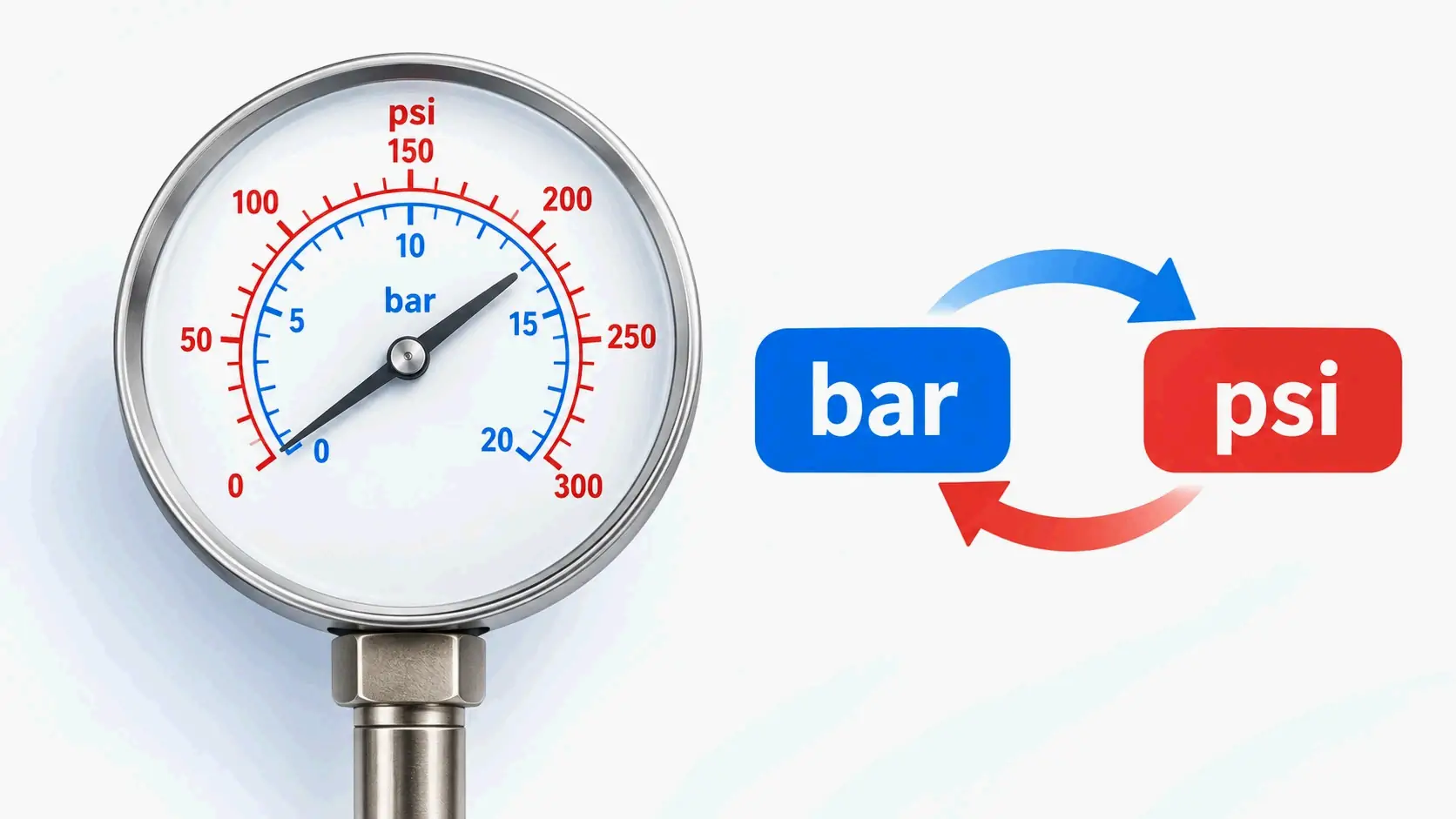
Bar to PSI: Quick Conversion Formula, Chart & Examples
To convert bar to psi, multiply by 14.5038. That means 1 bar = 14.5038 psi, or about 14.5 psi for quick math. To go the other way, multiply psi by 0.0689476. One atmosphere is close but not identical: 1 atm = 1.01325 bar = 14.696 psi. For example, 2.5 bar is roughly 36.3 psi, and 10 bar is about 145 psi.
How to Convert Bar to PSI: Step-by-Step Formula Using 14.5038
The whole conversion comes down to one multiplier: psi = bar × 14.5038. As Tradukka shows, 1 bar equals 14.5038 psi. To reverse the calculation, multiply psi by 0.0689476, which is the same relationship turned around. You really only need to remember one direction.
Follow these steps to convert any bar reading to psi:
- Identify the bar value. Look at the tire label, compressor manual, gauge, or product spec to find the pressure in bar.
- Choose your precision level. Use 14.5038 for exact engineering work or spreadsheets. Use 14.5 for quick field estimates.
- Multiply.
bar × 14.5038 = psifor exact conversion, orbar × 14.5for a fast approximation. - Round only at the end. Keep full decimals during the calculation, then round the final psi value to a practical precision such as one decimal place.
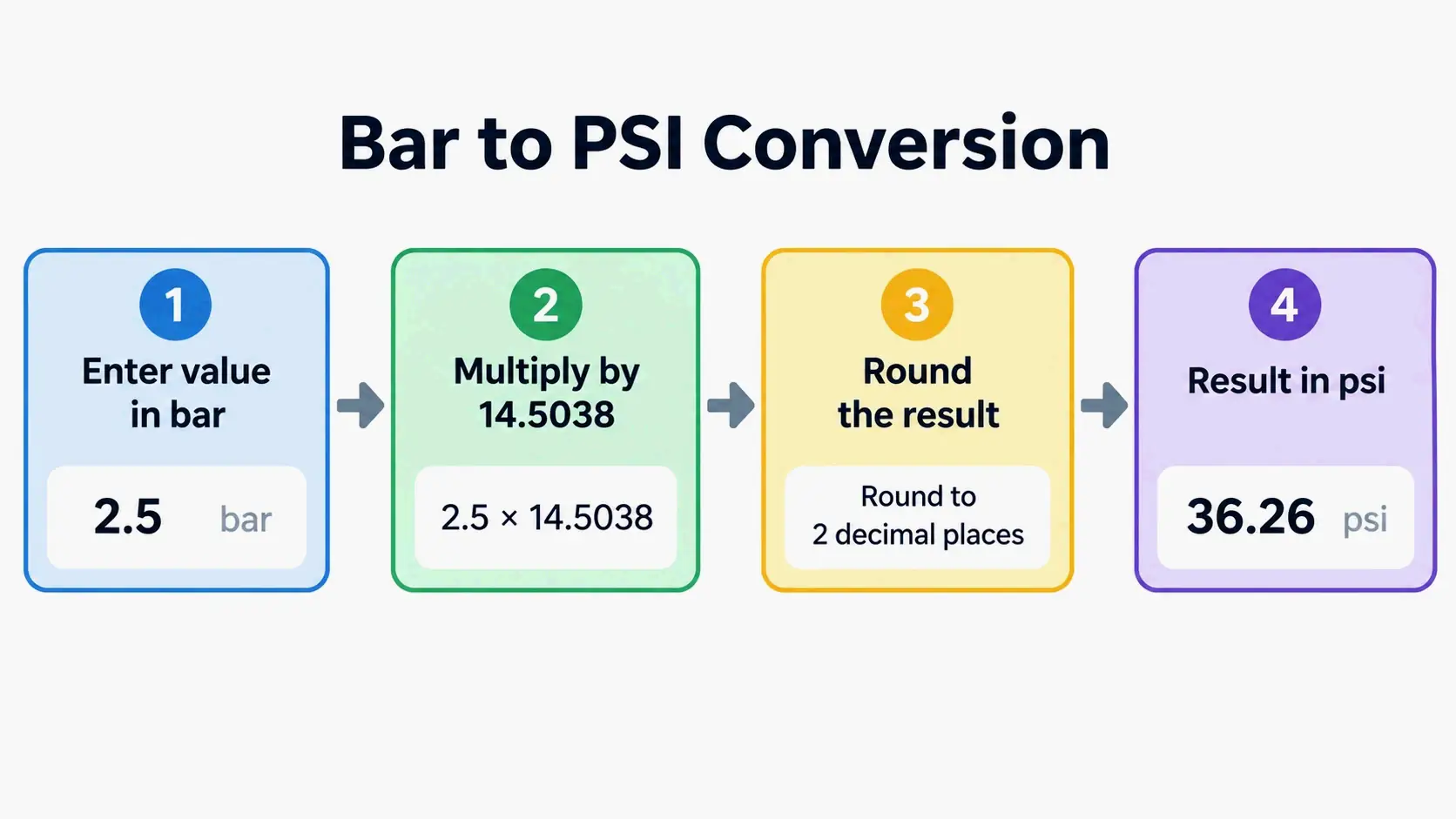
Here’s a worked example. Convert 2.5 bar: 2.5 × 14.5038 = 36.2595 psi, which most people round to 36.3 psi. You can do the same in a calculator by typing 2.5 * 14.5038, or in a spreadsheet with =A2*14.5038 if cell A2 holds the bar value.
The bar to psi formula
The exact formula is psi = bar × 14.5038. That factor stays the same no matter what you’re measuring. For instance, 3 bar × 14.5038 = 43.5114 psi, and 5 bar × 14.5038 = 72.519 psi.
Reverse conversion: PSI to bar formula
To convert psi back to bar, use bar = psi × 0.0689476. For example, 30 psi × 0.0689476 = 2.068 bar. That’s the same as dividing by 14.5038, so 145 psi ÷ 14.5038 ≈ 10 bar.
Mental math shortcut for bar to psi
A quick mental shortcut: multiply bar by 14.5, then add a small correction of about 0.026% if you need more precision. For example, 10 bar × 14.5 = 145 psi, and the correction takes it to 145.038 psi. For everyday tire checks, 14.5 is usually close enough.
Bar to PSI Conversion Chart: Common Values (1–100 Bar)
The table below uses the standard 14.5038 factor, matching the conversion data published by Tradukka and Besto Calculator.
| Bar | PSI (bar × 14.5038) |
|---|---|
| 1 | 14.5038 |
| 2 | 29.0076 |
| 3 | 43.5114 |
| 5 | 72.519 |
| 10 | 145.038 |
| 50 | 725.19 |
| 100 | 1,450.38 |
These values cover common ranges, from low-pressure water systems up to industrial hydraulics. As a quick reference, 1 bar is close to 14.5 psi, 10 bar is close to 145 psi, and 100 bar is close to 1,450 psi.
When should you use the exact 14.5038 instead of the rounded 14.5? Stick with 14.5 for tire inflation, home appliances, or rough comparisons where a fraction of a psi won’t affect safety or performance. Use 14.5038 for engineering calculations, calibration, certification, or anything where small pressure differences matter.
PSI to bar quick reference table
| PSI | Bar (psi × 0.0689476) |
|---|---|
| 10 | 0.689 |
| 30 | 2.07 |
| 50 | 3.45 |
| 100 | 6.895 |
| 145 | 10.0 |
This reverse table comes in handy when a US tire gauge shows psi but the vehicle manual lists bar. For example, a common passenger tire at 30–35 psi is about 2.1–2.4 bar, which lines up with the range you see above.
What Are Bar and PSI? Unit Definitions and the Pascal Bridge
The bar is a metric pressure unit equal to exactly 100,000 pascals. It’s widely used in Europe and in industrial and scientific work. Besto Calculator points out that the bar isn’t an official SI unit, but it’s accepted in practice because it gives convenient numbers for tire pressure, hydraulic systems, air compressors, and gas systems. One bar is roughly equal to average atmospheric pressure at sea level, which is why it feels intuitive in many situations.
PSI, or pounds per square inch, is the imperial/US unit of pressure. It measures force per unit area: PSI = Force (pounds) ÷ Area (square inches). Besto Calculator notes that psi is the standard for vehicles, tires, and mechanical systems in the United States. A typical passenger vehicle tire may need around 30–35 psi.
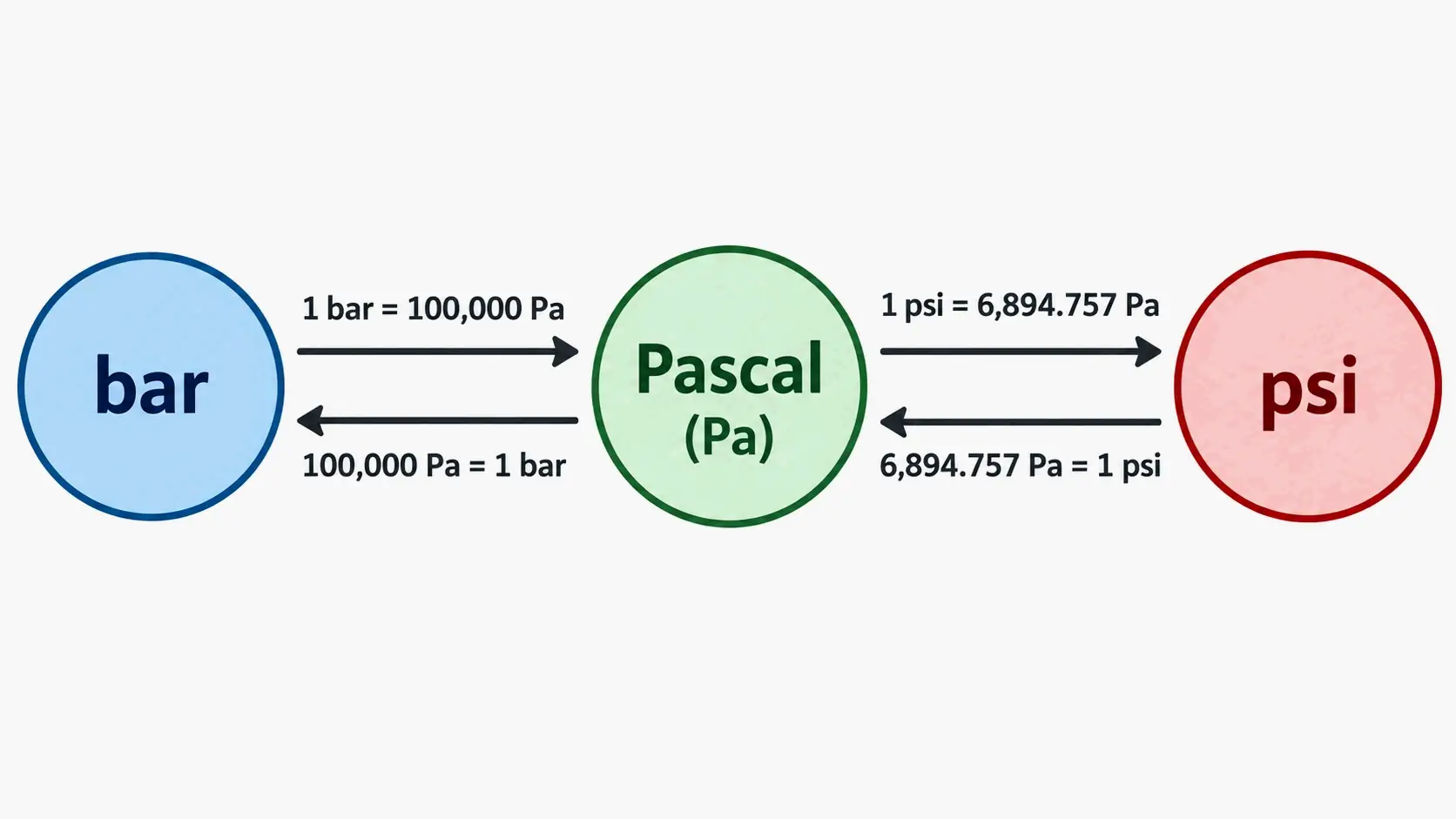
The pascal (Pa) is the SI base unit for pressure, equal to one newton per square meter. It connects bar and psi because both can be expressed in pascals. According to Best Tool Online, 1 psi equals 6,894.757 pascals, or 6.895 kPa. Since 1 bar equals 100,000 Pa, the bridge is complete: 100,000 Pa is one bar, and 6,894.757 Pa is one psi.
Gauge Pressure vs Absolute Pressure: Why It Matters for Bar to PSI Conversions
Most everyday pressure readings are gauge pressure, written as psig or bar gauge. Gauge pressure measures pressure relative to the surrounding atmosphere, not from a perfect vacuum. Absolute pressure, written as psia or bar absolute, includes atmospheric pressure in the total.
Tires, air compressors, and pressure cookers normally display gauge pressure. So a tire reading of 32 psi gauge isn’t 32 psi absolute; absolute pressure would be about 46.7 psi at sea level because standard atmospheric pressure is about 14.7 psi. The same logic applies to bar: a reading of 2.1 bar gauge is about 3.1 bar absolute at sea level.
This distinction only changes your conversion when you’re comparing gauge and absolute readings. If you convert 2.1 bar gauge to psi using 14.5038, you get 30.5 psi gauge. But if you mistakenly compare that to an absolute psi specification, the numbers won’t line up because absolute includes the atmosphere.
Pressure cooking gives a clear example. According to Wikipedia’s pressure cooker reference, a gauge pressure of 1.0 bar (15 psi) produces a cooking temperature of about 121 °C (250 °F). That 1.0 bar is gauge pressure, not absolute pressure; the absolute pressure inside the cooker is about 2 bar because standard atmospheric pressure is already about 1 bar.
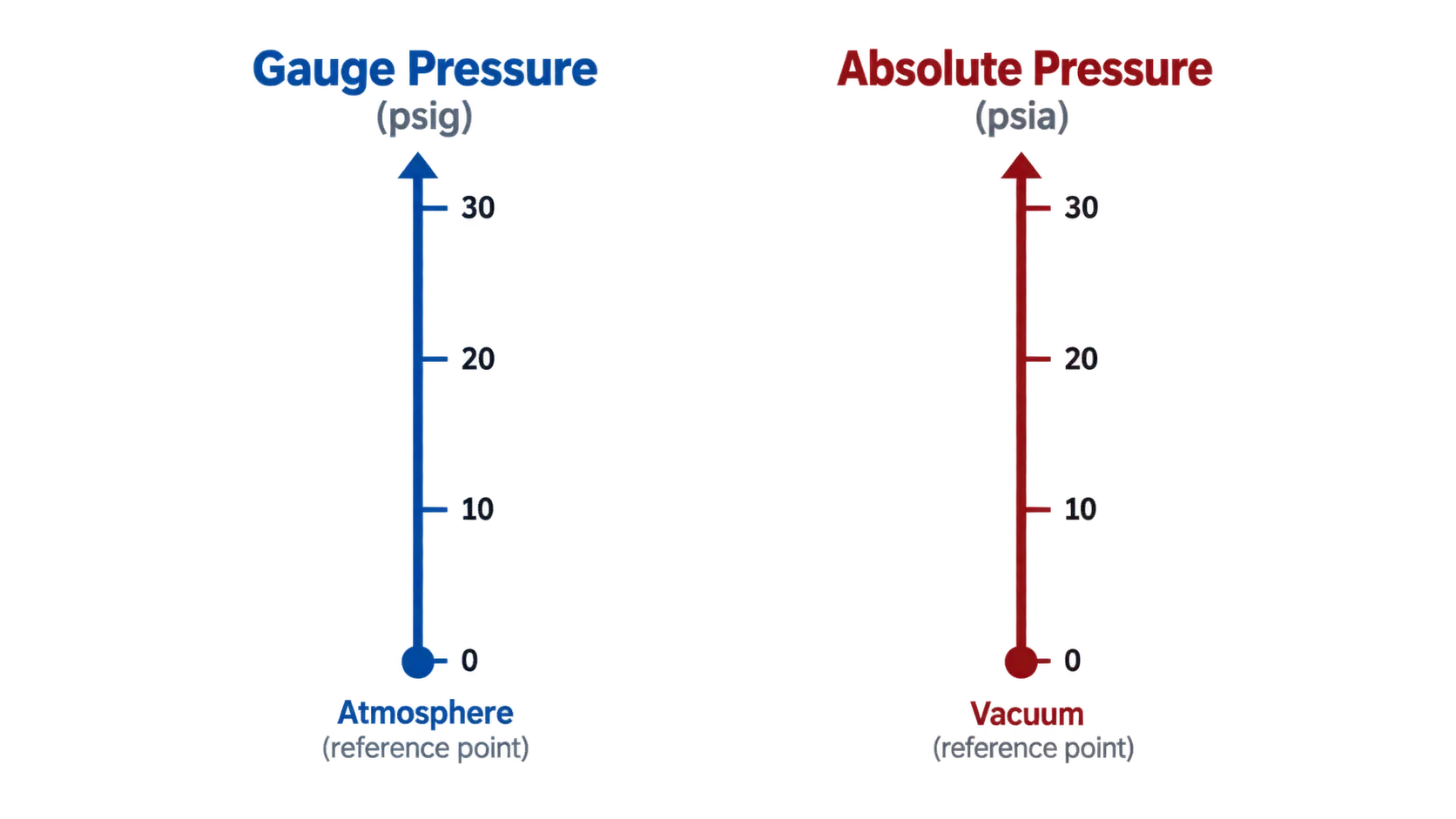
Psig vs psia: Which one does your device show?
Check the label or manual for abbreviations. psig and bar gauge mean gauge pressure; psia and bar absolute mean absolute pressure. Tire gauges, compressor regulators, and pressure cookers almost always use gauge units. Scientific instruments, weather reports, and some industrial sensors may report absolute pressure. If the unit isn’t labeled, see whether the reading returns to zero when open to air: gauge pressure reads zero, while absolute pressure reads about 14.7 psi or 1.013 bar at sea level.
Real-World Bar to PSI Conversions by Use Case
Different applications use different reference points, but the same 14.5038 multiplier applies once you know whether the reading is gauge or absolute.
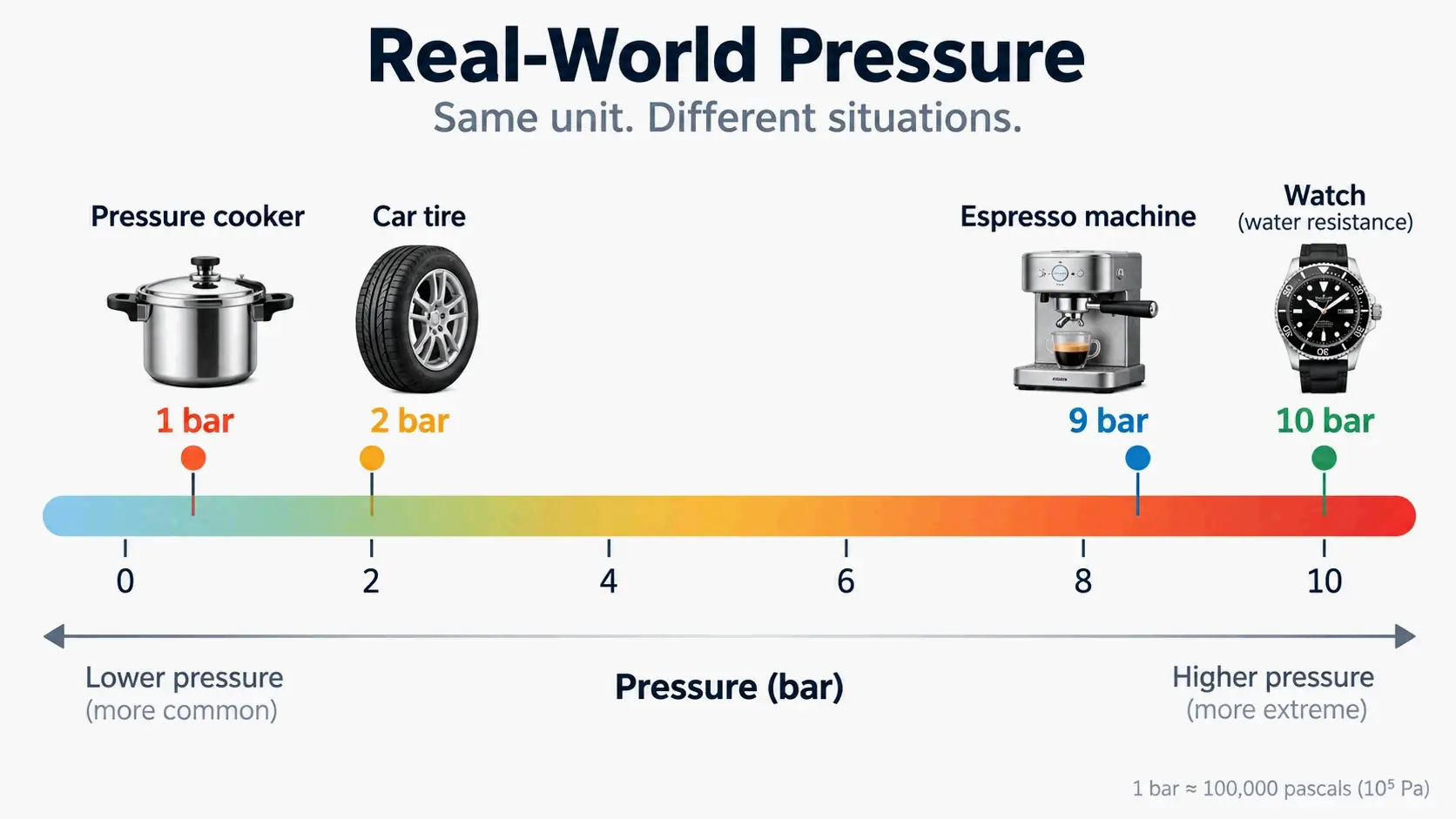
| Use case | Bar | PSI | Notes |
|---|---|---|---|
| Passenger car tire | 2.1–2.4 bar | 30–35 psi | Gauge pressure |
| Espresso machine | 9 bar | 130.5 psi | Brew pressure, usually gauge |
| Watch water resistance | 10 bar | 145 psi | Equivalent to 100 m depth rating |
| Pressure cooker | 1.0 bar gauge | 15 psi | About 121 °C cooking temperature |
| Air compressor | varies | varies | US models usually in psi; European models often in bar |
Automotive and bike tire pressure
According to Besto Calculator, a typical passenger vehicle tire needs around 30–35 psi, which is about 2.1–2.4 bar. Many European vehicles show tire pressure recommendations in bar, while American vehicles often use psi. For example, a 2.2 bar tire spec equals 2.2 × 14.5038 = 31.91 psi, close to 32 psi. Always check the vehicle’s door sticker or owner’s manual—not the tire sidewall—for the correct pressure.
Espresso, water resistance, and home appliances
Espresso machines commonly brew at 9 bar. Multiply by 14.5038 and you get 9 × 14.5038 = 130.53 psi, usually cited as about 130.5 psi. That’s one of the higher everyday pressures, though still below many hydraulic systems.
For watch water resistance, the Hamilton Khaki Field Murph 38mm specification lists a water resistance of 10 bar (100 m) / 145 psi (328 ft). That 145 psi figure is the direct conversion of 10 bar using 14.5038, which confirms that watch ratings expressed in bar can be read as a pressure equivalent in psi.
Pressure cookers work at lower gauge pressures. According to Wikipedia, a gauge pressure of 1.0 bar (15 psi) corresponds to a cooking temperature of about 121 °C (250 °F). Home espresso machines and pressure cookers both show why gauge pressure matters: the pressure value you see is above ambient pressure, not the total absolute pressure.
Air compressors show a regional split. Besto Calculator notes that European equipment often uses bar, while US models typically display psi. Before setting a compressor, check which unit the regulator shows and convert as needed to avoid over-pressurization.
Bar vs atm vs kPa: Complete Pressure Unit Conversion Matrix
Pressure units overlap, and the standard atmosphere is a common source of confusion. According to Wikipedia’s atmospheric pressure reference, the standard atmosphere (atm) is defined as 101.325 kPa, which equals 1,013.25 hPa, 14.696 psi, and 1.01325 bar. The same values appear in the pressure unit guide from Best Tool Online.
The table below covers the most common pressure units.
| Unit | Equivalent |
|---|---|
| 1 bar | 100,000 Pa = 100 kPa = 14.5038 psi = 0.986923 atm |
| 1 psi | 6,894.757 Pa = 6.895 kPa = 0.0689476 bar = 0.068046 atm |
| 1 atm | 101.325 kPa = 1.01325 bar = 14.696 psi |
| 1 kPa | 0.01 bar = 0.145038 psi = 0.00986923 atm |
| 1 MPa | 10 bar = 145.038 psi = 9.86923 atm |
For automotive work, psi and bar are the most practical units. For scientific and meteorological use, kPa and hPa often appear. MPa is common in high-pressure engineering and material specifications because 1 MPa equals exactly 10 bar.
Why bar and atm are not exactly the same
The bar was defined as a convenient multiple of the pascal, while the standard atmosphere is defined from the average sea-level pressure on Earth. According to Best Tool Online, 1 atm equals 1.01325 bar, so the difference is about 1.3%. In psi terms, that’s 14.5038 psi for 1 bar versus 14.696 psi for 1 atm. For most practical conversions, this difference is small, but it matters in calibration, weather data, and scientific work where a 1.3% gap can affect results.
Conclusion
Converting bar to psi comes down to one multiplier: 14.5038. But using the right pressure type and real-world context matters more than the math itself. Gauge pressure and absolute pressure describe different things, and mixing them up can lead to incorrect settings. Save the formula, keep the conversion chart nearby, and always confirm whether your device reads gauge or absolute pressure before applying a conversion. With that check in place, bar to psi conversion becomes a fast, reliable step rather than a source of error.
FAQ
Is 1 bar the same as 1 atmosphere (atm)?
No. One atm equals 1.01325 bar and 14.696 psi, while 1 bar equals 14.5038 psi. The difference is about 1.3%, small for everyday use but relevant in scientific or calibration work.
What is 2.5 bar in psi?
Multiply 2.5 by 14.5038 to get 36.2595 psi. For practical use like tire inflation or equipment settings, that’s typically rounded to 36.3 psi.
How do I convert psi back to bar?
Divide the psi value by 14.5038, or multiply by 0.0689476. For example, 30 psi × 0.0689476 = 2.068 bar, which matches a common passenger car tire pressure range.
What does 10 bar water resistance mean in psi?
Ten bar equals about 145 psi and corresponds to a water resistance rating of approximately 100 meters. This rating appears in watch and diving equipment specifications, such as the Hamilton Khaki Field Murph 38mm.
Does car tire pressure use bar or psi?
US vehicles typically display tire pressure in psi, while European vehicles often use bar. A common passenger tire range is 30–35 psi, or about 2.1–2.4 bar. Always check the vehicle’s door sticker for the recommended value.
SectoJoy
• Indie Hacker & DeveloperI'm an indie hacker building iOS and web applications, with a focus on creating practical SaaS products. I specialize in AI SEO, constantly exploring how intelligent technologies can drive sustainable growth and efficiency.