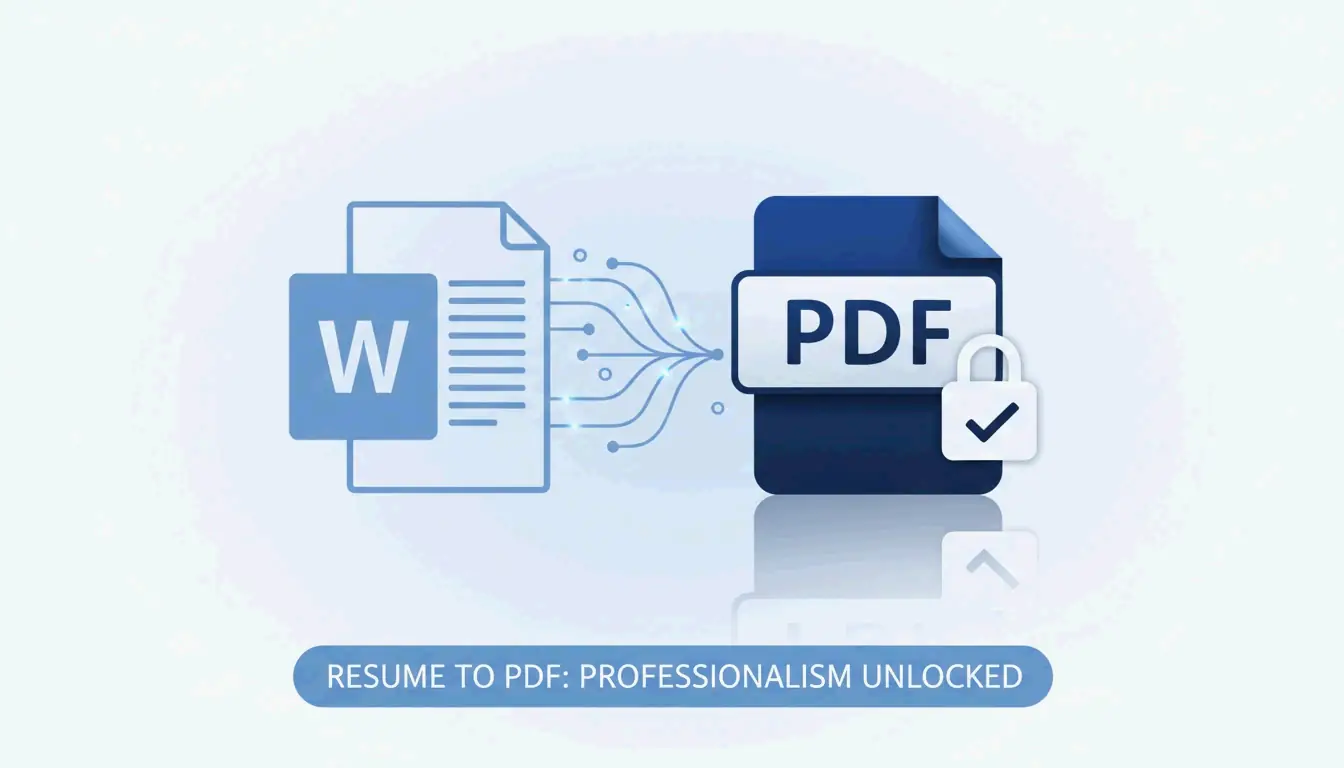
Creating Electronic Resumes: How to Perfectly Convert Word to PDF (2026)
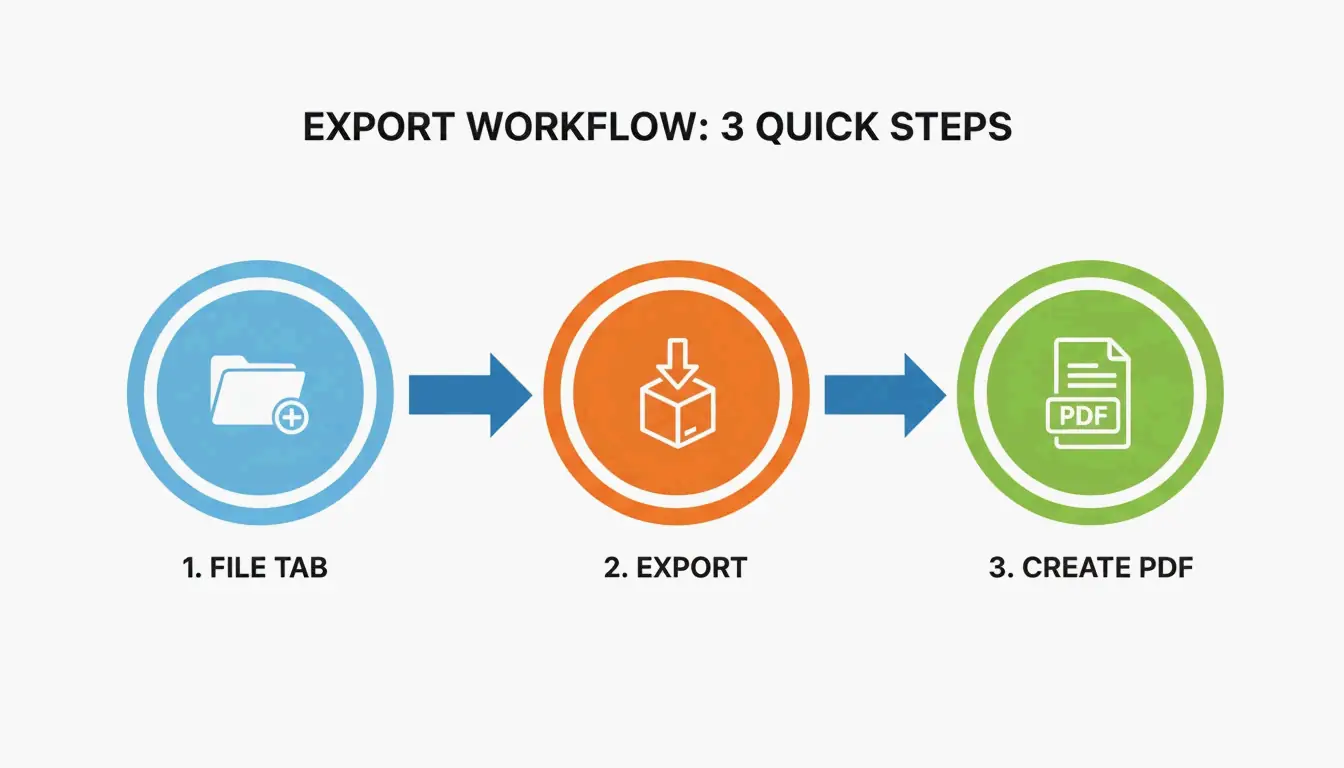
To convert a Word resume to PDF, open the document in Microsoft Word → File → Export → Create PDF/XPS. Select “Standard (publishing online and printing)” for best quality. This preserves formatting, keeps hyperlinks active, and ensures ATS readability.
Word to PDF: 6-Step Export
| Step | Action | Why |
|---|---|---|
| 1 | Open final draft in Microsoft Word | Use your master .docx file |
| 2 | Click File tab | Top-left corner |
| 3 | Select Export (or Save As) | Both paths work |
| 4 | Choose PDF (*.pdf) format | From dropdown |
| 5 | Select “Standard” optimization | Preserves metadata + hyperlinks |
| 6 | Click Publish | Done |
Critical: Use Export or Save As — never “Print to PDF”, which flattens hyperlinks and can alter layout.
Why PDF Over DOCX for Resumes
| Factor | DOCX | |
|---|---|---|
| Formatting consistency | Varies by device/software | Locked — identical everywhere |
| Font rendering | Depends on installed fonts | Embedded in file |
| Spell-check lines | Red/blue squiggles visible | Removed — clean output |
| Hyperlinks | Active | Active (via Export) |
| ATS readability | Good | Good (if text-based) |
| File tampering | Easy to edit | Locked |
Doroteya Vasileva, CPRW at Enhancv confirms PDFs eliminate formatting drift and spell-check artifacts.
ATS Compatibility: The 5-Second Test
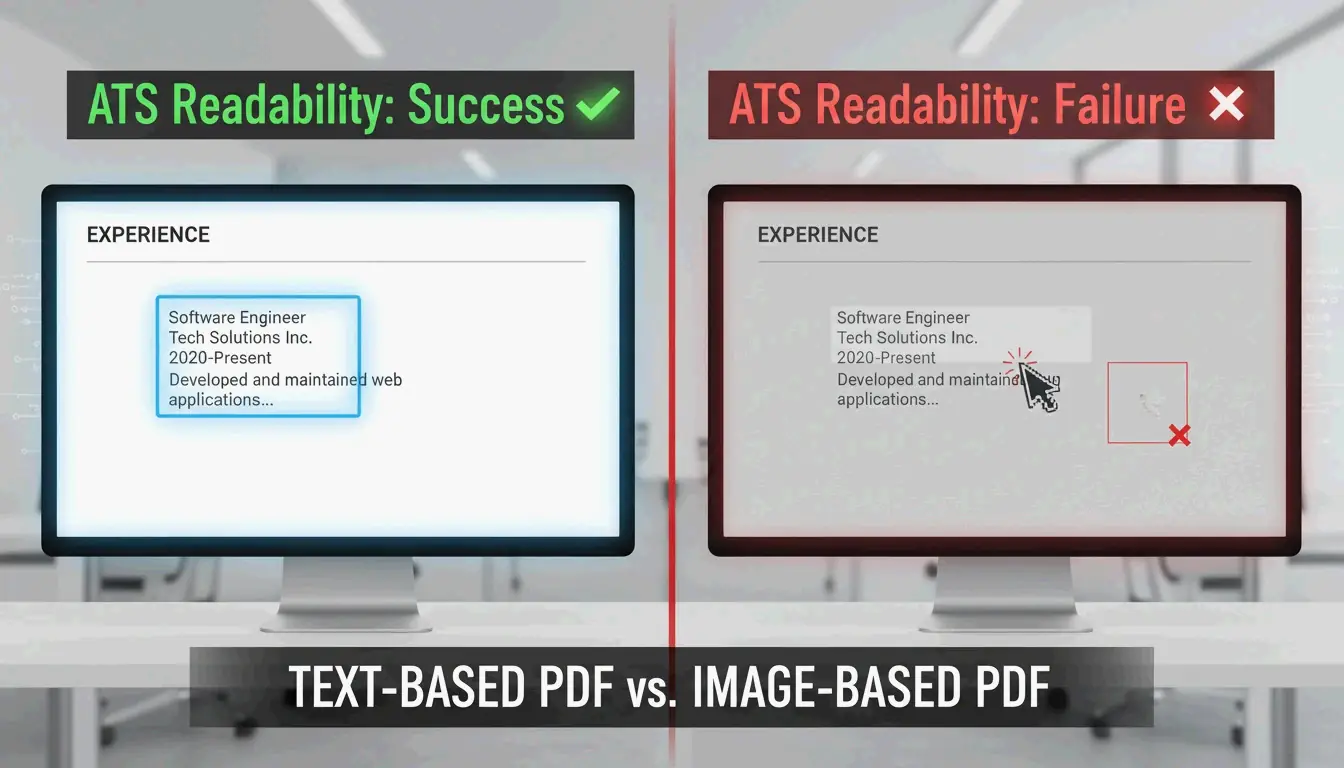
Modern ATS reads text-based PDFs without issue. Verify with this quick test:
- Open your PDF
- Highlight a sentence with your mouse
- Copy the text
- Paste into Notepad (Windows) or TextEdit (Mac)
| Result | Meaning | ATS Status |
|---|---|---|
| Readable text | Text-based PDF | Pass — ATS-friendly |
| Gibberish / symbols | Encoding issues | Fail — fix source document |
| Can’t select text | Image-based PDF | Fail — ATS will reject |
Per Enhancv, keep margins at 0.5–1.0 inch to prevent ATS from clipping edge text.
Export Method Comparison
| Method | Hyperlinks | Layout Accuracy | ATS Readable |
|---|---|---|---|
| File → Export | Preserved | High | Yes |
| File → Save As PDF | Preserved | High | Yes |
| Print to PDF | Lost | May shift | Possibly |
| Online converter | Varies | Varies | Varies |
Always use Export or Save As — never Print to PDF.
Alternative Tools
| Tool | Best For | Limitation |
|---|---|---|
| Microsoft Word (desktop) | Full control, hyperlinks | Requires license |
| Google Docs (File → Download → PDF) | Free, basic resumes | Complex layouts may break per IBTimes UK |
| pdfFiller | Batch conversion, eSignatures | 12,500+ G2/Capterra reviews |
| Adobe Acrobat DC | PDF editing, password protection | Paid |
Mobile Rendering Check
Recruiters often scan resumes on phones. Before submitting:
- Email the PDF to yourself
- Open on your phone in Adobe Acrobat DC or default viewer
- Verify: font readable, text boxes intact, no layout collapse
- Test hyperlinks: LinkedIn, portfolio links still clickable
Resume Formatting Best Practices
| Setting | Recommendation |
|---|---|
| Margins | 0.5–1.0 inch (prevents ATS clipping) |
| Fonts | Standard system fonts (Arial, Calibri, Times New Roman) |
| Text boxes | Avoid floating — may not convert cleanly |
| Images | Avoid — ATS can’t read text inside images |
| File name | FirstName_LastName_Resume.pdf |
| File size | Under 1 MB for email/portal uploads |
Conclusion
File → Export → PDF in Microsoft Word preserves formatting, hyperlinks, and ATS readability. Always run the 5-second Notepad test to verify text-based output. Check mobile rendering before submitting. Keep your master .docx for future edits, but always send the PDF.
FAQ
What if my layout changes after converting to PDF?
Use standard system fonts (Arial, Calibri) that embed correctly. Avoid floating text boxes and complex graphics. Per Enhancv, stick to 0.5–1.0 inch margins to prevent content clipping during conversion.
Are hyperlinks still clickable after saving as PDF?
Yes — if you use Export or Save As. “Print to PDF” flattens the document and strips all hyperlinks. Always test links in a PDF viewer before submitting.
Should I submit PDF or DOCX for ATS?
PDF is preferred — it protects your visual branding. Only use DOCX if the job description explicitly requires it. Modern ATS handles both formats well, but always verify PDF readability with the Notepad test.
SectoJoy
• Indie Hacker & DeveloperI'm an indie hacker building iOS and web applications, with a focus on creating practical SaaS products. I specialize in AI SEO, constantly exploring how intelligent technologies can drive sustainable growth and efficiency.