CM til tommer: Komplett guide til formler, høydekonvertering og standarder
To convert cm to inches, divide by 2.54. Formula: inches = cm ÷ 2.54. For quick estimates, multiply by 0.39. This ratio is fixed by the NIST and the 1959 International Yard and Pound Agreement — it applies to every conversion, from height tracking to CNC machining.
Conversion Methods
| Method | Formula | Example (30 cm) | Precision |
|---|---|---|---|
| Exact | cm ÷ 2.54 | 30 ÷ 2.54 = 11.811 in | Full |
| Multiply | cm × 0.3937 | 30 × 0.3937 = 11.811 in | Full |
| Mental estimate | cm × 0.39 | 30 × 0.39 ≈ 11.7 in | ~1% error |
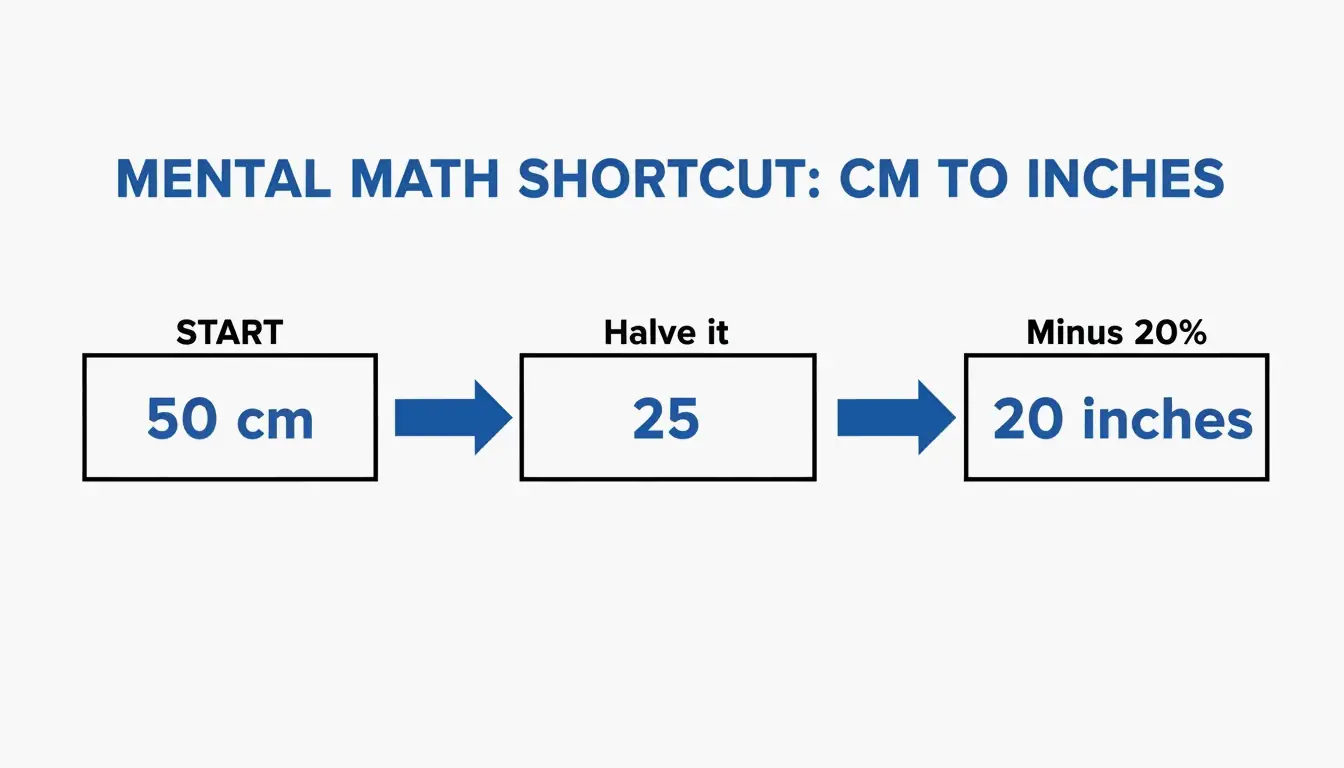
| Halve & subtract 20% | (cm ÷ 2) × 0.8 | 50 cm → 25 → 20 in | ~1.5% error |
Go Tools confirms a standard 30 cm ruler = 11.81 inches.
Quick Conversion Table
| Centimeters | Inches (exact) | Feet + Inches |
|---|---|---|
| 1 cm | 0.394 in | — |
| 10 cm | 3.937 in | 3′ 15/16″ |
| 30 cm | 11.811 in | 11′ 13/16″ |
| 50 cm | 19.685 in | 1′ 7 11/16″ |
| 100 cm | 39.370 in | 3′ 3 3/8″ |
| 150 cm | 59.055 in | 4′ 11 1/16″ |
| 159 cm | 62.598 in | 5′ 3″ (avg woman) |
| 171 cm | 67.323 in | 5′ 7″ (avg man) |
| 178 cm | 70.079 in | 5′ 10″ |
Height averages per Best Calculators.
Height Conversion: cm to Feet + Inches
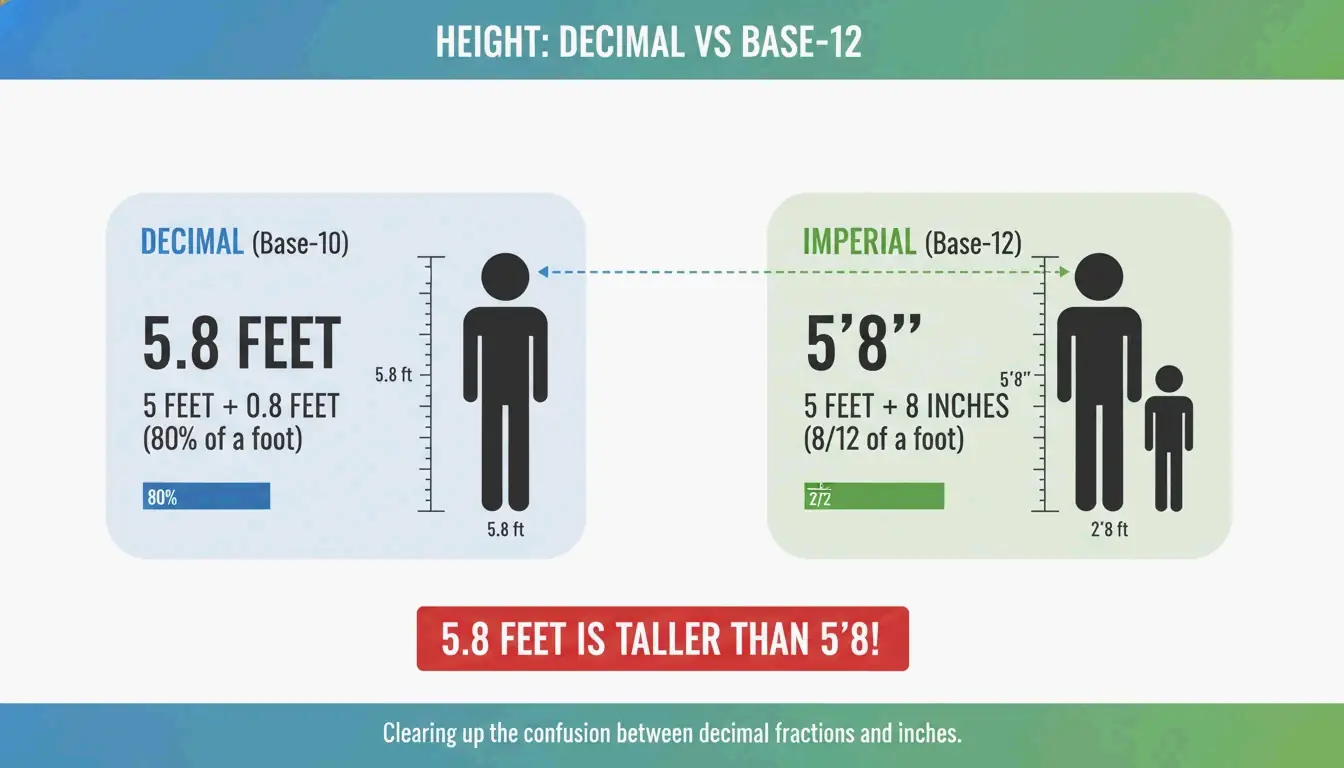
Critical: Decimal feet ≠ feet + inches. 5.8 feet is 5 feet + 9.6 inches, NOT 5 feet 8 inches.
Two-Step Method
- Total inches: cm ÷ 2.54 (e.g., 171 ÷ 2.54 = 67.32 in)
- Split: ÷ 12 for feet, remainder is inches (67.32 ÷ 12 = 5 ft, 7.32 in → 5’7″)
Best Calculators and the WHO recommend recording height in centimeters for medical accuracy.
Standards: NIST and the 1959 Agreement
| Standard | Definition | Status (2026) |
|---|---|---|
| International inch | Exactly 2.54 cm (25.4 mm) | Active |
| International foot | Exactly 0.3048 m | Active |
| US Survey Foot | 1 m = 39.37 in (slightly different) | Retired Jan 1, 2023 per NIST |
All professional mapping and engineering in 2026 must use the international foot (0.3048 m).
Precision Warning
Using 0.39 instead of 0.3937 creates a 0.7 mm error per meter — exceeding the ±0.05 mm tolerance for precision CNC machining, per Go Tools.
Practical Applications
Screen Diagonals
| Screen Size | Diagonal (cm) | Approximate Width (cm) |
|---|---|---|
| 55-inch TV | 139.7 cm | ~121.8 cm |
| 27-inch monitor | 68.6 cm | ~59.8 cm |
| 13-inch laptop | 33.0 cm | ~28.6 cm |
Go Tools notes screen width is always less than the diagonal measurement.
Paper Sizes
| Standard | Size | In Inches |
|---|---|---|
| US Letter | 21.59 × 27.94 cm | 8.5 × 11 in |
| A4 | 21.0 × 29.7 cm | 8.27 × 11.69 in |
A4 is 0.6 cm narrower but 1.76 cm taller than US Letter. Incorrect scaling between these standards ruins print layouts.
Developer Implementation
// Exact factor per 1959 Agreement
const CM_PER_INCH = 2.54;
const cmToInches = (cm) => cm / CM_PER_INCH;
def cm_to_inches(cm):
    inches = cm / 2.54
    assert abs(inches * 2.54 - cm) < 1e-10
    return inches
Excel: =CONVERT(A1, "cm", "in") — uses official international standards.
Conclusion
cm ÷ 2.54 = inches. For casual use, the 0.39 shortcut works. For engineering, medical, or construction work, always use the exact 2.54 factor — small rounding errors compound over distance. As of 2026, the international foot (0.3048 m) is the only legal standard for professional work.
FAQ
Why is 1 inch exactly 2.54 cm?
The 1959 International Yard and Pound Agreement unified US and British imperial systems with the metric system. The international yard was set at exactly 0.9144 meters, making 1 inch = 25.4 mm = 2.54 cm.
How do I convert cm to fractional inches for woodworking?
- Divide cm by 2.54 to get decimal inches
- Take the decimal portion and multiply by your desired denominator (e.g., 16 for 1/16ths)
- Round to nearest whole number for the fraction
Is a centimeter larger than an inch?
No. 1 inch = 2.54 cm. A centimeter is roughly fingernail width; an inch is closer to adult thumb width.
How to use Excel for cm to inches conversion?
Use =CONVERT(number, "cm", "in") — this uses NIST international standards and is the most accurate method for bulk spreadsheet conversions.
SectoJoy
• Indie Hacker & DeveloperI'm an indie hacker building iOS and web applications, with a focus on creating practical SaaS products. I specialize in AI SEO, constantly exploring how intelligent technologies can drive sustainable growth and efficiency.